zombie castaways what happens when you change your girlfriend back to a human
How to Make a Zombie (Seriously)
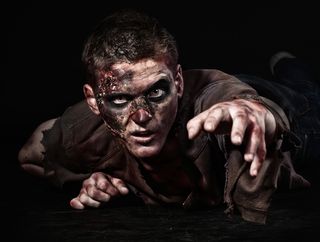
The slouching, flesh-eating zombie has get one of the almost in-vogue creatures in electric current Tv set and movie offerings, appearing in films like "Globe State of war Z" and in the AMC series "The Walking Dead."
Most rational people scoff at the suggestion that zombies are real, but a number of respected medical experts and academic journals take presented prove that zombies are, in fact, real.
To understand the zombie miracle and its Haitian roots, an appreciation of the practice of vodou (sometimes spelled voodoo or vodun) is needed. A religion based in West Africa, voodou is still practiced in varying forms throughout the Caribbean, Brazil, the American South and other places with a potent African heritage. [Zombie Facts: Existent and Imagined (Infographic)]
Vodou spirituality has a rich tradition of fetish objects, including the so-called "voodoo doll." Practitioners of vodou also place a particular importance on herbal remedies and other concoctions that may include animal parts, such as bones and hair, stale plants, shells, minerals or other ingredients.
Toads, worms and human remains
Vodou priests known as bokor create a white, powdery compound chosen coupe poudre, co-ordinate to numerous reports. The ingredients in this powder allegedly can turn a person into a zombie. In the 1980s, Harvard ethnobotanist Wade Davis traveled to Haiti to investigate zombies and "zombie powder."

Though different bokor used different ingredients in their powders, Davis found that "at that place are five abiding animal ingredients: burned and ground-up homo remains [usually bone], a small tree frog, a polychaete [segmented] worm, a big New World toad, and one or more species of pufferfish. The most stiff ingredients are the pufferfish, which comprise deadly nerve toxins known every bit tetrodotoxin," Davis wrote in Harper'southward Magazine.
Some in the scientific customs have criticized Davis' research — his investigation was published in 1983 in the Journal of Ethnopharmacology — but his identification of tetrodotoxin as the active ingredient in zombie powder has considerable scientific merit.
Euphoria, and then death
Several animals comprise tetrodotoxin in their tissues; the liver, eyes and ovaries of the pufferfish (genus Takifugu) accept especially high amounts of the lethal nerve toxin. Though regarded equally a delicacy in Japan, the fish and some of its organs (specially the liver) are banned every bit food items in many places because of the dangers.
In small amounts, tetrodotoxin causes numbness, tingling and a not-unpleasant sensation of floating — even euphoria — according to reports from dauntless gourmands who have sampled carefully prepared pufferfish. High levels of the toxin, withal, tin cause decease inside minutes due to respiratory failure.
Just at sublethal doses, the toxin can leave a victim in a country of suspended animation: Breathing is subdued and barely perceptible by observers, the heart rate is near cypher, just the person remains conscious and aware (though unable to speak). [Zombie Animals: 5 Real-Life Cases of Body-Snatching]
Zombie slavery
This toxin, then, may form the ground of the zombie phenomenon. According to Davis and other observers, a person who is exposed to a certain corporeality of zombie pulverisation containing tetrodotoxin can slip into a vegetative land resembling death. Soon afterwards the person is buried, their body is exhumed by a bokor.
Though the exhumed zombie usually suffers from apoxia (oxygen deprivation) caused by breathing the limited amount of air within a coffin, the bokor wields control over the person by continually administering a 2nd drug, a psychoactive compound derived from the jimson weed (Datura stramonium). This 2d drug causes delirium and disorientation, rendering the person incapable of normal functioning.
The British medical journal The Lancet published iii accounts of "zombification" in 1997. In one case, a woman who was presumed dead and was cached in a family unit tomb reappeared three years later — she was positively identified past several family unit members and townspeople. "After a local court authorized the opening of her tomb, which was full of stones, her parents were undecided whether to accept her home, and she was admitted to the psychiatric hospital in Port-au-Prince," the authors wrote.
Because death certificates and other official niceties are rare in rural Haiti, and because burying generally occurs inside a day of death, "it is not implausible for a retrieved person to be alive," the authors added. "The use of Datura stramonium to revive them, and its possible repeated administration during the period of zombie slavery, could produce a state of farthermost psychological passivity."
The legal condition of zombies
A well-known report of a zombie comes from the pages of ChemMatters, the publication of the American Chemical Order. In 1962, a homo named Clairvius Narcisse was admitted to Albert Schweitzer Hospital in Port-au-Prince with astringent respiratory issues. After slipping into a coma, Narcisse was later alleged dead by 2 hospital doctors and was buried soon thereafter.
18 years later, in 1980, a human shuffled up to Angelina Narcisse in a village market and identified himself as her brother. He related a story of being buried alive, dug up and enslaved on a distant sugar plantation. Doctors who examined Narcisse — and dozens of villagers and family members — positively identified him as the man who was buried in 1962.
Merely if you're tempted to make a zombie slave of your own, be aware that the zombie phenomenon is considered and then existent in Haiti that it's specifically outlawed.
Article 249 of the Haitian penal code states, "It shall besides be qualified as attempted murder the employment which may be made against whatever person [using] substances which, without causing actual death, produce a lethargic blackout more or less prolonged. If, later on the person had been buried, the human activity shall be considered murder no affair what result follows."
Follow Marc Lallanilla on Twitter and Google+ . Follow united states of america @livescience , Facebook & Google+ . Original article on LiveScience .
Source: https://www.livescience.com/40690-zombie-haiti-are-zombies-real.html
0 Response to "zombie castaways what happens when you change your girlfriend back to a human"
Post a Comment